Beyond the Label by Maureen Chiquet
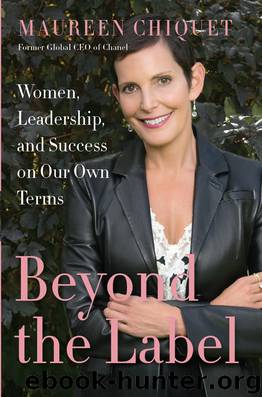
Author:Maureen Chiquet
Language: eng
Format: epub
Publisher: HarperCollins
Published: 2017-02-22T05:00:00+00:00
After my six-month stint as a trainee and another year as an assistant, I had finally become a part of the merchant “club,” meaning I was promoted to associate merchandiser (still of Socks and Belts, alas) and could now rub shoulders with the “merch” managers, talk about how much I might buy of one item or another, kvetch about schlepping my samples from place to place, and share anxiety over the fearsome OTB, even if my area of responsibility seemed a little, well, let’s say, random.
As a merchant, there was no escaping the necessity of fully immersing yourself in the production process and knowing every detail about your product category. While an individual merchant’s knowledge depended largely on his or her category, all Gap merchants were expected to know the origins and specification of their raw materials, the way each item was made, and how their merchandise was finished. If you were a “wovens” merchant, you learned about the “warp” and the “weft.” You understood costs per yard and you could calculate a fair “cut and sew” price, depending on labor rates in the country where the goods were made. As a knit or sweater merchant, you became an expert on gauges, yarn counts, and spinning techniques. A denim guru could describe the exact process of sandblasting and recognize a type of fabric just by the selvage. At the time, I thought it was silly to learn so many tedious details. Couldn’t we just trust our vendors to provide what we needed? Couldn’t they take the prototypes and copy them? At L’Oréal, we had labs, and while we spent time understanding the formulas, we weren’t all required to have doctoral degrees in chemistry. But at Gap, becoming intimate with every possible influence in the process—from design specifications to the arrival of the item in stores—was considered crucial to running the business; this meant regular visits to the countries and factories that made our products.
I had already been anticipating visiting exotic places like Hong Kong, where so many of my colleagues traveled to meet our business partners. But my destiny? High Point, North Carolina, home of sock mills, furniture manufacturers, and “broasted” chicken (battered and baked, just one step away from fried). I would be responsible for checking the production of the crew socks I had ordered and ensuring our “sock wall”—the valuable real estate just behind the cash register in each and every Gap store—was chock-full of the right colors and quantities.
Crew socks: At first I couldn’t understand why we sold so many of them, but apparently someone liked them . . . a lot. At the time, crews were almost 60 percent of our sock business. Many customers picked up a pair or two to match their pocket tees, enticed by sales associates who were trained to ask each customer: “Can I get you some crew socks with your tees?” It was our version of the would-you-like-fries-with-that gambit—an “add-on” purchase that, at $2.50 a pop, made it easy for customers to say yes.
Download
This site does not store any files on its server. We only index and link to content provided by other sites. Please contact the content providers to delete copyright contents if any and email us, we'll remove relevant links or contents immediately.
Hit Refresh by Satya Nadella(9140)
When Breath Becomes Air by Paul Kalanithi(8449)
The Girl Without a Voice by Casey Watson(7890)
A Court of Wings and Ruin by Sarah J. Maas(7855)
Do No Harm Stories of Life, Death and Brain Surgery by Henry Marsh(6944)
Shoe Dog by Phil Knight(5271)
The Rules Do Not Apply by Ariel Levy(4972)
A Higher Loyalty: Truth, Lies, and Leadership by James Comey(4965)
Hunger by Roxane Gay(4929)
Tuesdays with Morrie by Mitch Albom(4788)
Everything Happens for a Reason by Kate Bowler(4745)
The Immortal Life of Henrietta Lacks by Rebecca Skloot(4592)
Millionaire: The Philanderer, Gambler, and Duelist Who Invented Modern Finance by Janet Gleeson(4481)
How to Change Your Mind by Michael Pollan(4358)
All Creatures Great and Small by James Herriot(4326)
The Money Culture by Michael Lewis(4211)
Man and His Symbols by Carl Gustav Jung(4138)
Elon Musk by Ashlee Vance(4129)
Tokyo Vice: An American Reporter on the Police Beat in Japan by Jake Adelstein(3997)
